
Surrey Nanosystems: Engineering the darkness that enables the future of space
Surrey NanoSystems has spent the past decade shaping the optical foundations of modern space systems. Best known for creating Vantablack, the world-famous ultra-black coating, the company has grown from a university spin-out into a trusted engineering partner for companies across Europe and the US. Its materials sit at the heart of sensitive optical payloads, star trackers and emerging laser communications systems, yet the business is far from relying on the reputation of its headline material. Today it is redefining how the sector approaches stray-light management, component design and the future of satellite surfaces.
The company emerged from the University of Surrey, where early work on carbon nanotubes for semiconductor applications unexpectedly revealed a new class of ultra-dark coating. That discovery set Surrey NanoSystems on a new trajectory. Its flagship material, Vantablack, launched commercially in 2014 and made an immediate impact on the space industry. The first hyperspectral analyser to use it achieved a dramatic reduction in baffle size, cutting system weight to around seventy kilograms, compared with earlier NASA designs approaching half a tonne, by exploiting the coating’s unique absorption properties.
As missions grew more demanding, particularly in defence and high-precision earth observation, Vantablack became the premium solution for controlling stray light. Absorbing up to 99.85 per cent of incident radiation from UV to far infrared, it has been adopted widely for baffles, cold shields and star-tracker assemblies where accuracy depends on eliminating unwanted reflections. In parallel, the company discovered a different set of opportunities in automotive sensing. Advanced driver-assistance systems depend on clean optical signals, and Vantablack offered a route to improved glare control.
However, as the satellite industry shifted towards large constellations, a new challenge emerged. Operators faced mounting scrutiny over the impact of spacecraft brightness on astronomical observations. While Vantablack is effective, it must be process is a plasma reactor under vacuum and once applied it cannot be touched or easily cleaned without risk of damage. For high-end payload components this is manageable; for larger satellite structures it is not.
Surrey Nanosystems responded by launching the government-backed Scorpion programme to create an entirely new material. The result is Vantablack 310, a next-generation coating already generating strong interest among European primes. VB310 can be applied using conventional spray technologies and even supplied in aerosol form, bringing Vantablack technology to the higher volume / lower cost demands associated with the emerging new space market. Crucially, it can be handled, touched and cleaned without degrading performance. Developed using a new siloxane-based chemistry, it offers near-zero outgassing with minimal baking and functions in extremely thin films, supporting strict mass budgets. With optical performance around two per cent total hemispherical reflection, outperforming legacy paints on the market, VB310 delivers a modern alternative to technologies that have remained largely unchanged for decades.
Yet Surrey NanoSystems’ ambitions extend well beyond materials supply. Under CEO Nick Crofts, the business is repositioning itself as a photonics engineering solutions provider. Too often, Crofts explains, customers approach the company with completed hardware and request that it simply be “made blacker”, missing the opportunity to design out stray-light issues from the outset. The team now encourages primes to share CAD models early, enabling Surrey NanoSystems to apply its optical modelling expertise and BRDF datasets to optimise baffle geometries before they reach manufacture. This approach produces lighter, more efficient and more manufacturable components than those retrofitted with coatings at the end of the design cycle.
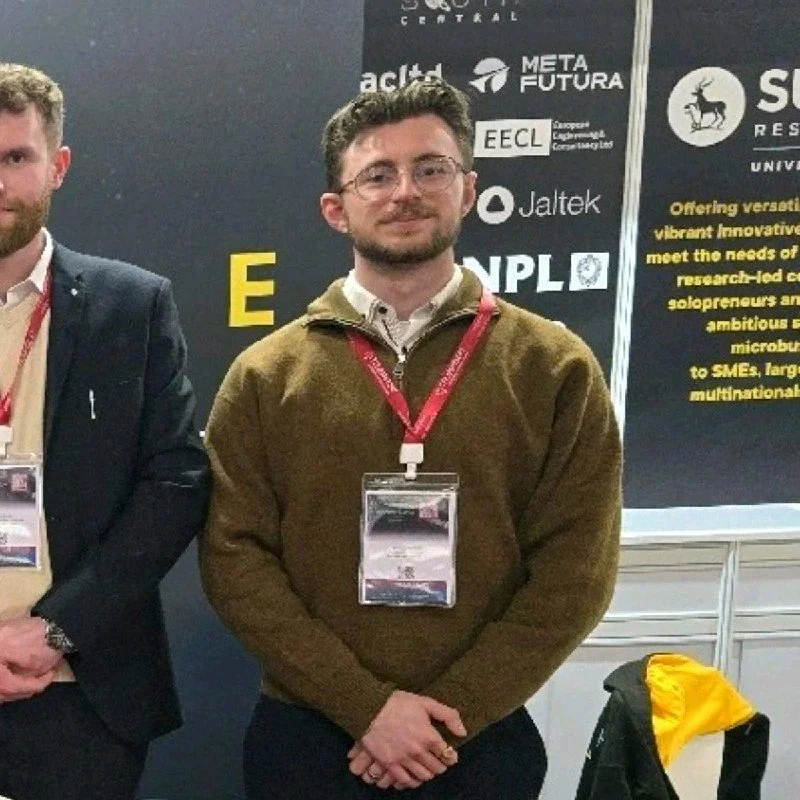
James Whitfield, technical lead.
Much of this capability is being advanced by R&D lead for space, James Whitfield, who has grown with the business from graduate to technical lead. By integrating modelling into customer engagement, Whitfield and the engineering team can quantify performance improvements and demonstrate how geometry and coating interact to suppress stray light. This strengthens early-stage collaboration and aligns optical design with real-world manufacturing constraints.
Throughout this evolution, Surrey Nanosystems has continued to draw on the regional strengths that helped shape it. A recent collaboration with the University of Surrey examined how coatings and satellite geometry influence orbital brightness, feeding into the International Astronomical Union’s Dark and Quiet Skies initiative. The research has been presented at national and international astronomy forums and incorporated into PhD work, reinforcing Surrey NanoSystems’ longstanding ties with regional universities and the wider space community.
The Space South Central cluster plays a growing role in the firm’s development. Local testing and qualification capabilities, including vibration, shock and environmental facilities at organisations such as MALLARD and the University of Surrey, are essential for bringing new coatings like VB310 to market in a sector where approvals take years and evidence requirements are demanding.

Nick Crofts, CEO.
Nick Crofts, Surrey NanoSystems CEO, said: “At Surrey NanoSystems we believe innovation isn’t just about creating a better material — it’s about rethinking how space systems are designed from the outset. Whether we’re improving sensor fidelity or reducing satellite brightness, our aim is to provide practical, high-performance solutions that allow us to push optical capabilities further and support the next generation of space technology.”
From its origins in a university cleanroom to its present role at the forefront of photonic engineering, Surrey NanoSystems exemplifies the type of innovation that thrives within the Space South Central cluster. With VB310 entering the market and photonics engineering now central to its strategy, Surrey Nanosystems is supplying the tools and the insight that modern missions increasingly demand.