New programme for international space investment announced at UCL innovation hub
The UK space minister joined researchers, entrepreneurs and industry representatives at UCL’s IDEALondon for the announcement of a new programme to attract international space investment to the UK.
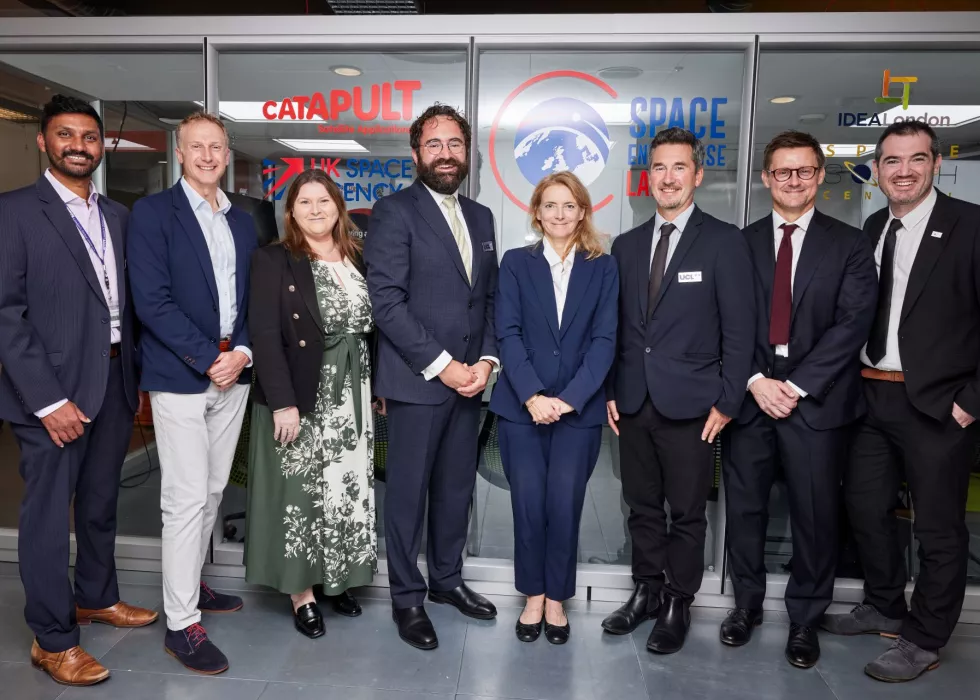
From Left to Right: Kemil Thomas, Principal Partnerships Manager at UCL, Alexander Holt, Managing Director of Seraphim Space Enterprise, Antonia Yendell, Head of Space Ecosystem Development at the UK Space Agency, Dr Robert Thompson, Vice-Dean (Enterprise) for the Faculty of Engineering Sciences at UCL, Baroness Lloyd of Effra CBE, Parliamentary Under-Secretary of State for Space, Cyber and Regulatory Reform, Dr William Lovegrove, Director of Strategic Innovation Partnerships at UCL, Mark Saxon, Chief of External Affairs at Satellite Applications Catapult, Tobias Marchant, International Partnership Manager at Space South Central.
Alongside Baroness Lloyd of Effra CBE, Parliamentary Under-Secretary of State for Space, Cyber and Regulatory Reform, UCL and its industry collaborators Seraphim Space VC, Space South Central (SSC), and the Satellite Applications Catapult announced the launch of the new UK Space Landing Pad Programme.
The programme is a six-month pilot designed to attract and support international space companies with high potential that are looking to establish a commercial presence in the UK. The first five participants in the programme will be announced later this year.
It offers structured mentorship, regulatory guidance, technical facilities, and direct exposure to commercial partners and investors to help ease these companies’ entry to the UK market.
Historically, the UK’s commercial space sector, though quite capable, has been fragmented and difficult for unfamiliar international companies to enter, which the UK Space Landing Pad Programme is seeking to address.
IDEALondon is an innovation hub helping early startup teams to grow and scale that was founded by UCL Engineering and operated by WilbelLAB. In addition to allocating space at IDEALondon, UCL is providing additional research support by sharing its academic expertise, talent pipelines and collaborative R&D capabilities.
UCL has a strong track record in space science, innovation and commercialisation and is a global leader in sustainable space development and innovation. It hosts the UCL Space Enterprise Lab which provides space innovators free access to the tools and facilities needed to fast-track new products, projects and partnerships.
Professor Andy Nisbet, Dean of the UCL Faculty of Engineering Sciences, said, "This is a great opportunity to show the world what the UK can do to promote space innovation. We have a tremendous ecosystem of highly capable institutions and experts, of which UCL is one, that are poised to achieve great things. The UK Space Landing Pad Programme brings these national assets together with international partners to support the UK’s goals in orbit.”
The investment firm Seraphim Space VC is providing access to its international investor networks, commercial market expertise, and targeted mentorship to scale early-stage space technologies into market-ready enterprises.
Alexander Holt, Managing Director of Seraphim Space Enterprise, said, "As a global investor, Seraphim seeks to attract best of breed companies into its portfolio.
“Teaming up with UCL, Space South Central and the Satellite Applications Catapult to deliver a landing pad in London for high-potential scaling companies adds to both our offering to our companies but also the attractiveness of the UK as a global destination to grow and scale their UK and European operations.
“We are excited to see how the first cohort of companies make the best use of this opportunity.”
The regional space cluster Space South Central is the UK’s largest and home to a hub of industrial capability, academic research, and regional talent across Hampshire, Surrey, London and the broader southern space corridor.
The technology and innovation company Satellite Applications Catapult will help make available world-class testing facilities, specialised technical expertise, and domain networks to ensure foreign space capabilities integrate into the broader UK satellite and data infrastructure.
Mark Saxon, Chief of External Affairs at the Satellite Applications Catapult, said, "We want to help our best companies to export, but we also want to drive foreign direct investment into the UK.
“We want to land companies which can grow here, bring new capabilities to the UK and become suppliers and customers to our existing sector. The return will be UK jobs, UK revenue and expanded UK supply chains. This initiative will help us find the best ways to do that.”
During its pilot phase, five programme participants will receive six months of intensive support, including: introductions to potential UK customers, suppliers, investors and strategic partners; validation on a range of technical, commercial and regulatory issues; dedicated workspace and other logistical support; and access to established investor networks and communities to develop long-term investment and funding.
Ultimately, the pilot programme is meant to be a first step towards integrating its international participants with the UK space sector through lasting engagement with different regions, specialist facilities and test ranges across the country.
During her visit announcing the new programme, the Minister toured the facilities at IDEALondon where the Landing Pad companies will be based. She met with representatives of Blue Skies Space Limited, which is based there, as well as other UCL start-ups and spinouts, including Verra Space and Nibras Communication Limited.
UCL has a long-standing track record of space innovation and international collaboration. It is one of 32 ESA_LABs worldwide, partnerships between universities and the European Space Agency that support industry-focused research, commercialisation and entrepreneurship. UCL has fostered numerous space startups, spanning fields from space science to in-orbit manufacturing, and has contributed directly to more than 200 space missions. Through the Mullard Space Science Laboratory (MSSL) and its predecessor, Rocket Group, the university has helped shape generations of space science and technology innovation while supporting the growth of the UK’s space sector.
Tobias Marchant, International Partnership Manager for Space South Central, said, "We are delighted to be working with UCL, Seraphim and Satellite Applications Catapult to bring the UK Space Landing Pad to fruition. This collaboration will help strengthen international links, support innovation and create new opportunities for ambitious space businesses looking to establish and grow in the UK.”
UCL Vice-Provost (Research, Innovation & Global Engagement) Professor Geraint Rees said, "UCL is home to some of the country’s leading expertise on foundational space science and cutting-edge space research.
“It is exciting to join with our partners and share that knowledge with international companies looking to invest in the UK. The UK Space Landing Pad Programme promises to put the nation at the forefront of space industry innovation.”
Earlier this year, the Government launched its new UK Space Strategy, shifting the nation’s space efforts toward national security, defence and industrial growth. With £7.8 billion in funding through to 2030, the new framework prioritises domestic supply chains and critical infrastructure.