
Public Attitudes to the Space Industry Revealed in the PAS 2025 Report
Jeremy Thomas, Outreach and Public Engagement Fellow from the University of Portsmouth’s Institute of Cosmology and Gravitation has written a piece for Space South Central regarding the Public Attitudes to Space (PAS) studies.
For 25 years, the Public Attitudes to Science (PAS) studies have been the UK’s most high-profile surveys on public perceptions of science, taking place every three to five years since 2020. The latest survey was conducted in early 2025 and a report on its findings was commissioned by UKRI and published in January 2026 (https://pas.ipsos.com/).
Amongst the questions asked of the 5281 participants were some that were specifically about the Space Industry and responses to these revealed a concerning lack of knowledge of the sector as well as a majority belief that risks associated with it outweigh its benefits. The report does not provide any insights into the reasoning leading to these responses, but it seems important to raise awareness of these issues in the space sector and even to suggest that further investigation is required urgently to get to the bottom of why the British public feels this way.
The report is accompanied by a spreadsheet of response data with over thirteen hundred response categories tabulated. This allows for responses to be analysed in terms of many sub-groups such as age, UK regions, male or female gender, level of education and even aspects such as religious engagement which I won’t cover here. The responses to questions about the Space Industry were also asked about other sectors or applications such as Nuclear Power, Vaccinating People Against Diseases, AI and Driverless Cars so it is also informative to see how attitudes to the Space Industry compare to some of these.
The first question asked about specific sectors or applications was about how well informed they felt about each example.
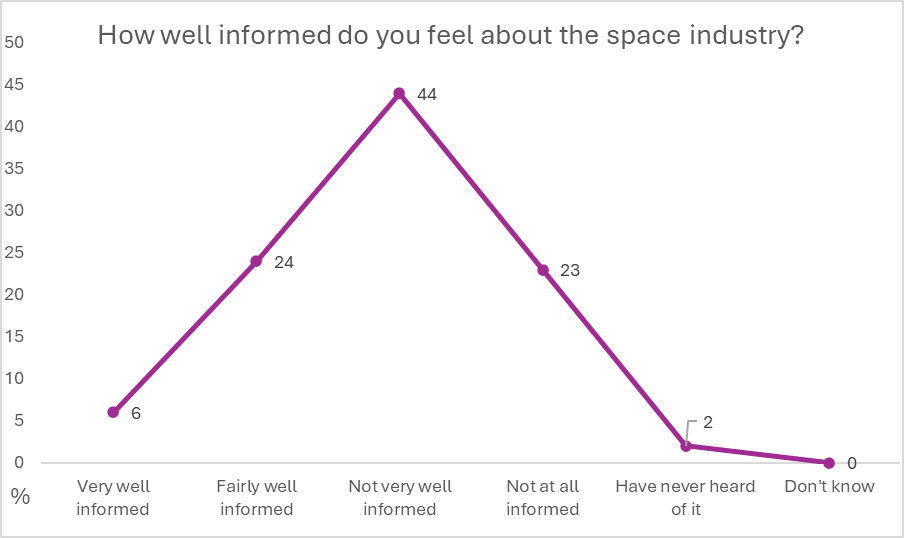
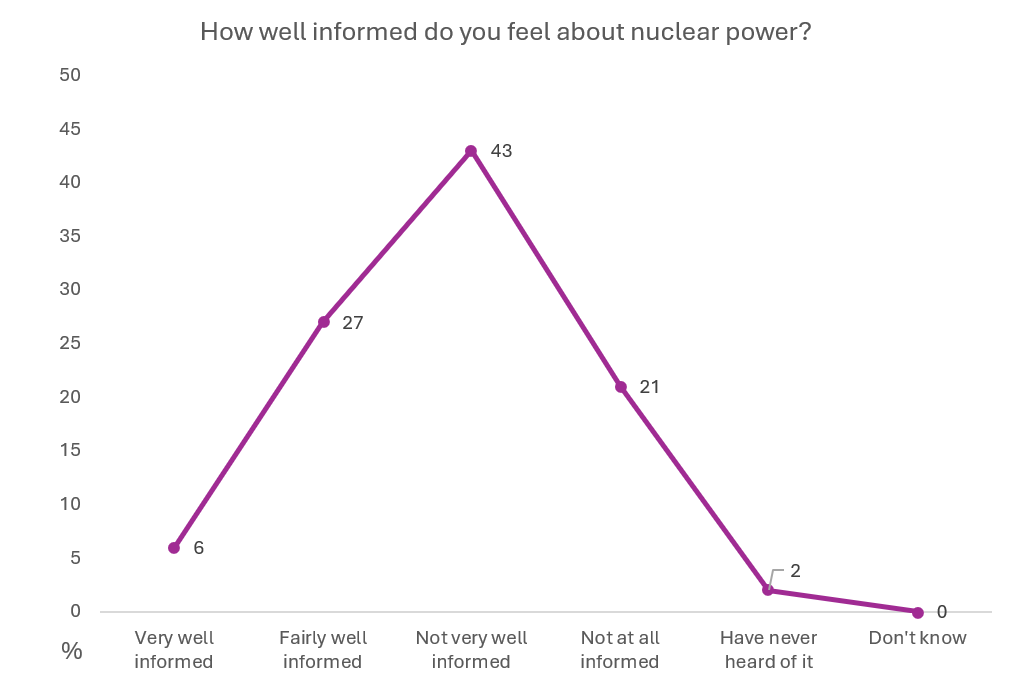
For comparison, the results for Nuclear Power, an industry which has had a history of public mistrust, showed that they felt slightly better informed about it than they did about the Space Industry, about a 3% difference in this case.
The second sector or application specific question asked about the perceived risks versus benefits of each example.
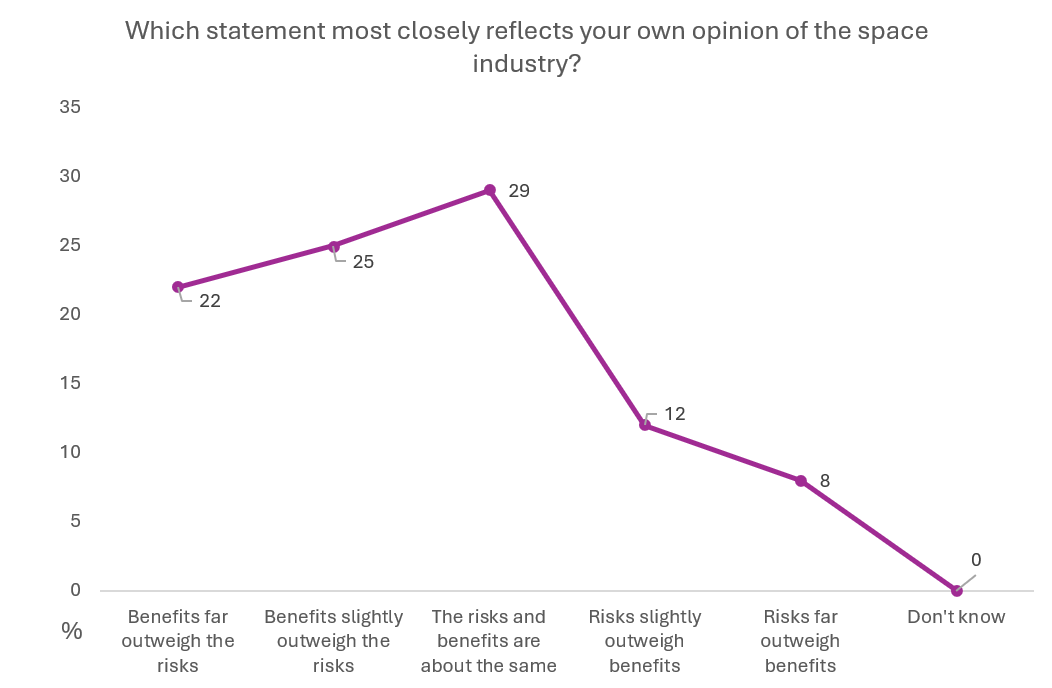
Only 47% of responses indicated that the public believe that the benefits of the Space Industry outweigh its risks. The survey results offer no insight into what the public perceive these risks and benefits to be, but it would be fascinating to find out what they think they are and what factors are influencing their responses. Once again, it is interesting to compare these responses with those for Nuclear Power.
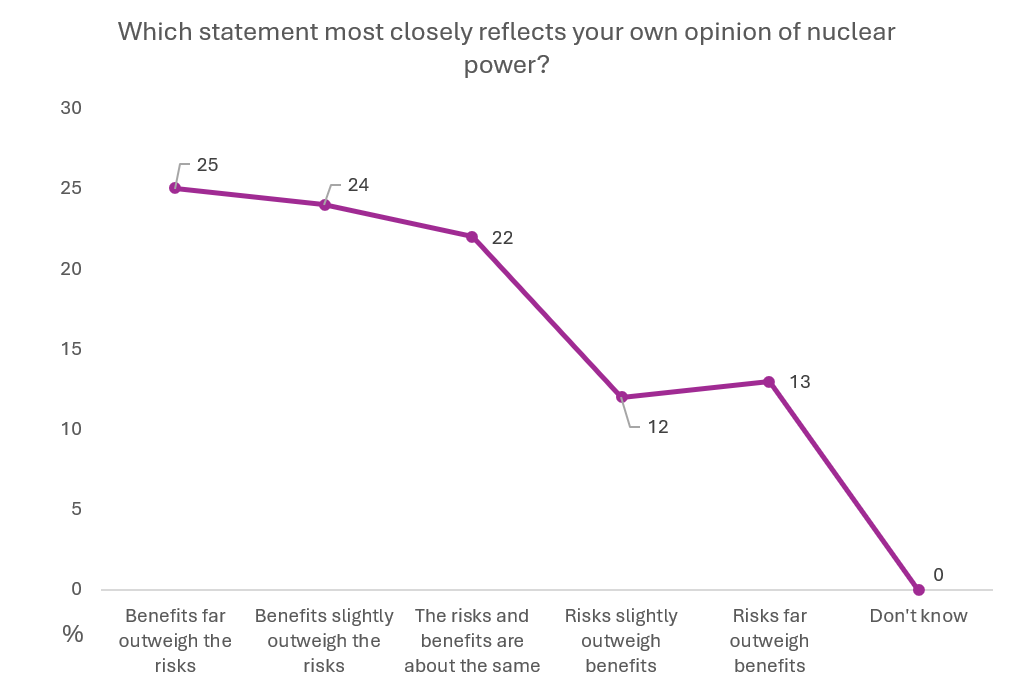
Here, 49% of respondents felt that benefits outweighed the risks which was 2% greater than for the Space Industry, although within the 2% error margin stated by IPSOS for the survey overall.
The authors of the PAS 2025 report commented on this perception of benefit versus risk on p.33:
“Looking across the questions on awareness and attitudes, on certain issues there is a link between awareness and favourability. For instance, the UK public felt relatively well informed about vaccinations and mobile phone technologies, which they also viewed positively.”
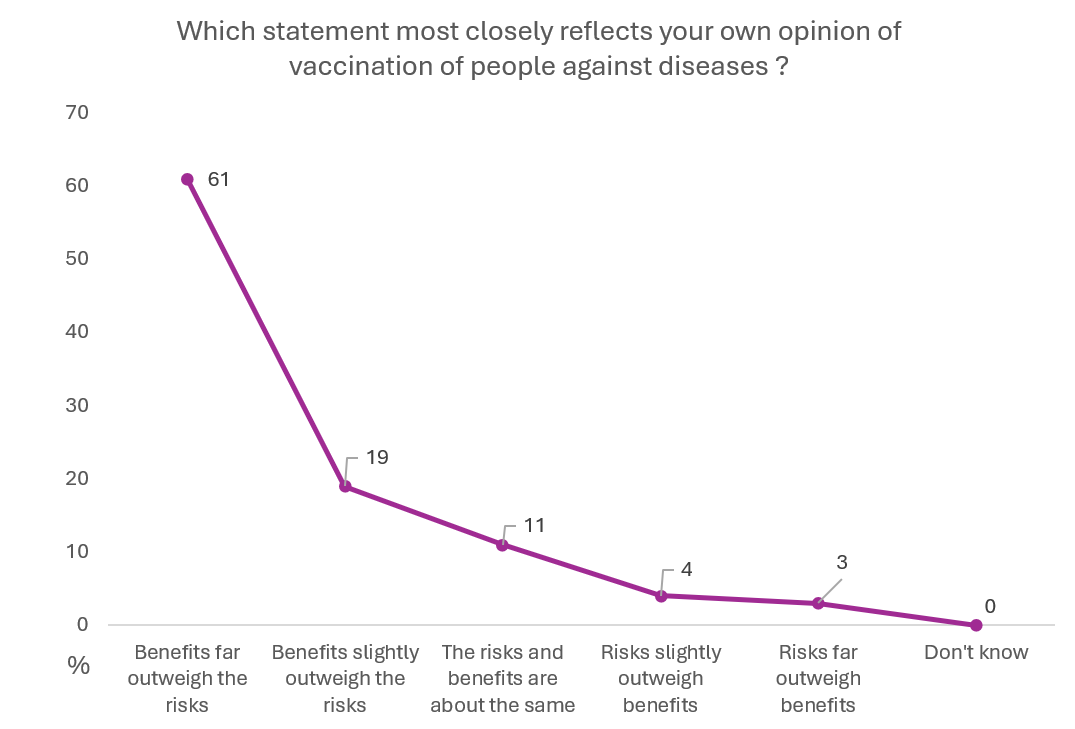
This indicates that the authors believe there are more positive responses to examples which people are familiar with and where they experience benefits directly in their everyday lives. By contrast, people may be benefitting from the Space Industry (and Nuclear Power) but they are not experiencing these benefits directly, only through using the technology which relies on space applications to work. An example of a much more positive view is when the same question is asked about Vaccinating People Against Diseases where 80% of respondents indicated that benefits outweigh the risks.
The full spreadsheet of data allows responses to these questions by sub-groups as well as for all respondents. Some highlights from the responses by these sub-groups are as follows.
For the first question, regarding how informed respondents felt about the Space Industry:
· 43% of male respondents gave positive responses compared to 24% of female respondents (other gender categories were not included due to low numbers of respondents in other categories)
· Overall, there was a steady decrease in positive responses by age group with 37% positive responses from 16-24 year olds but only 28% positive for those aged 65+
· Regional differences were not very marked, but London had the highest percentage of positive responses at 36% whereas the North East and South East (which includes the Space South Central Region) were lowest with 31% positive responses
(UK regions are defined from the standard NUTS Level 1 map https://geoportal.statistics.gov.uk/documents/ons::nuts-levels-1-and-2-january-2018-map-in-the-uk/explore )
· Qualification level did not make a large difference, being only 4% more positive between those qualified to higher degree level and those having no qualifications
· Degree subject made a larger difference with 52% positive responses from those with science and engineering degrees; 31% positive for arts and humanities graduates and 27% positive for social science graduates
· A respondent’s Science Capital Index made a significant difference. This is a measure of how much a person engages with STEM (Science, Technology, Engineering and Maths) in their everyday lives and through cultural experiences. For those with high science capital, 51% of responses were positive whereas 23% were positive for those with low science capital (https://blogs.ucl.ac.uk/aspires/category/science-capital/)
· The type of media used to access information about science and technology did make a significant difference to this question with 32% positive responses from those who accessed mainly traditional media, such as newspapers, books and TV, whereas 46% of responses were positive for those accessing mainly new media through platforms such as Instagram, TikTok and YouTube
For the second question of whether benefits outweigh the risks of the Space Industry:
· Responses from male respondents were 56% positive (i.e. benefits outweigh risks) compared to 36% for female respondents
· By age group, it was 25-34 year olds that were most positive at 51% with all other age groups being in the 46-48% range except those aged 65+ at 42%
· Regionally, the East Midlands had the lowest percentage of positive responses at 41% (despite being the location of the National Space Centre) and the North West had the highest with 56% positive. In the South East, 46% of responses were positive
· Level of qualification was a more significant factor in this question, those with Higher Degrees having 57% positive responses; undergraduate degree level 50% positive and those with no qualifications 39%
· The type of degree was again significant with 62% of responses positive from science and engineering graduates; 49% positive from arts and humanities graduates and 45% from social science graduates
· Socio-economic factors showed some differences in responses to this question, with 50% positive for those living comfortably on their current income compared to 43% positive for those finding it difficult to live on current income
· Science capital was again a significant factor with 61% positive responses from those with high science capital and 31% positive from those with low science capital
· Amongst those accessing information about science and technology from traditional media 44% gave positive responses whereas for those using new media 60% gave positive responses
This review is just a summary of some of the findings and data that can be found in the full PAS 2025 report focussing specifically here on questions related to the Space Industry. It is not intended to offer answers to the questions raised or even solutions to the problem of why the British public have largely negative views of the Space Industry either. However, I do hope that it has raised awareness of this important survey and its implications for those currently involved in the space sector which has such a significant impact on everyone’s lives and opportunities for future prosperity.