
Cluster universities help create the largest ever hi-res 3D map of the universe
The largest ever high-resolution, 3D map of the universe is now complete – and two of Space South Central’s academic partners were part of the project’s global team.
The University of Portsmouth and UCL were among 70 institutions working on the Dark Energy Spectroscopic Instrument (DESI) project, a major milestone in understanding the force driving cosmic expansion, and dark energy, one of the biggest mysteries in physics.
Located at the Kitt Peak National Observatory in Arizona, USA, DESI completed one of the most extensive surveys of the cosmos ever conducted ahead of schedule and delivered significantly more data than originally projected.
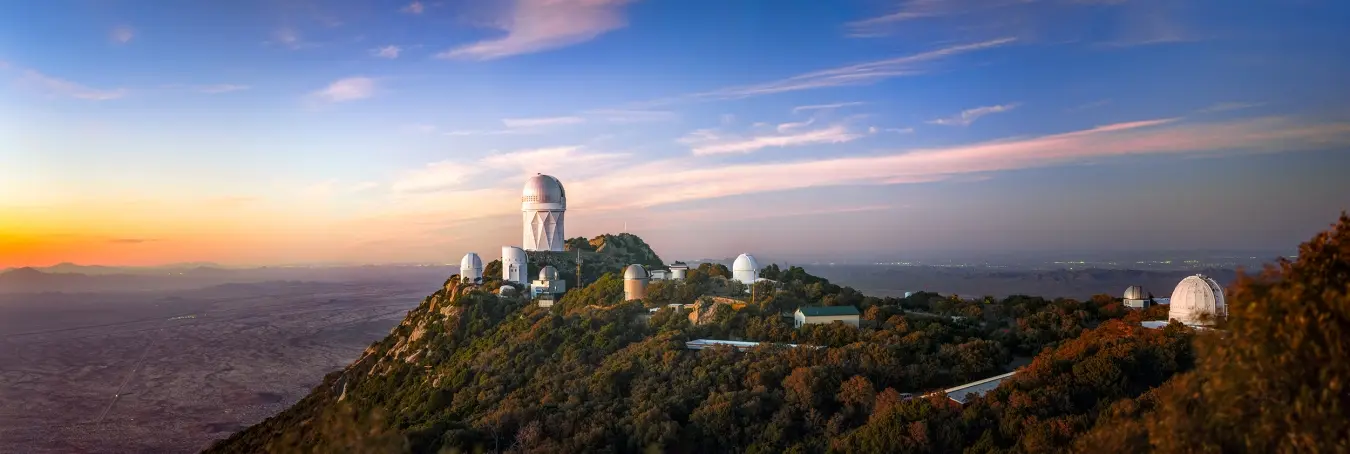
The Mayall Telescope at Kitt Peak National Observatory houses the Dark Energy Spectroscopic Instrument.
Credit: KPNO/NOIRLab/NSF/AURA/P. Horálek (Institute of Physics in Opava)
Researchers expected to gather data on 34 million galaxies and quasars during the five-year survey, but the instrument performed so efficiently that it captured more than 47 million galaxies and quasars, plus more than 20 million nearby stars used to study the Milky Way.
DESI has now collected cosmological data from six times as many galaxies and quasars as all previous surveys combined.
Scientists around the world are using the dataset to investigate dark energy, the mysterious force that makes up roughly 70 per cent of the universe and drives its accelerating expansion. By comparing how galaxies clustered billions of years ago with their distribution today, the DESI collaboration has traced dark energy’s influence across 11 billion years of cosmic history.
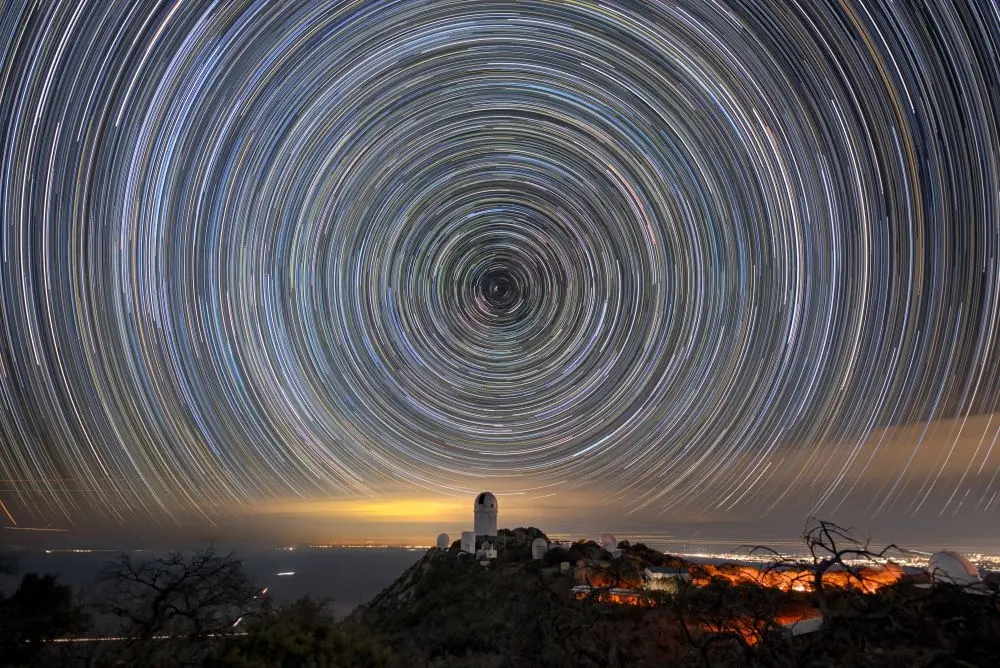
Star trails over the Mayall Telescope that houses DESI.
Credit: Luke Tyas/Berkeley Lab and KPNO/NOIRLab/NSF/AUR
Early results from the first three years of DESI data hinted that dark energy, long thought to be a ‘cosmological constant’, might be evolving over time. With the full five-year dataset now complete, researchers now have significantly more data to test whether this suggestion persists. If confirmed, it would mark a major shift in our understanding of the universe and its ultimate fate, which hinges on the balance between matter and dark energy.
Among the 900 DESI researchers are Dr Seshadri Nadathur, Associate Professor at the University of Portsmouth’s Institute of Cosmology and Gravitation (ICG), and UCL’s Perren Chair of Astronomy in its Astrophysics Group and Vice-Dean (International) of the UCL Faculty of Mathematical and Physical Sciences (MAPS).
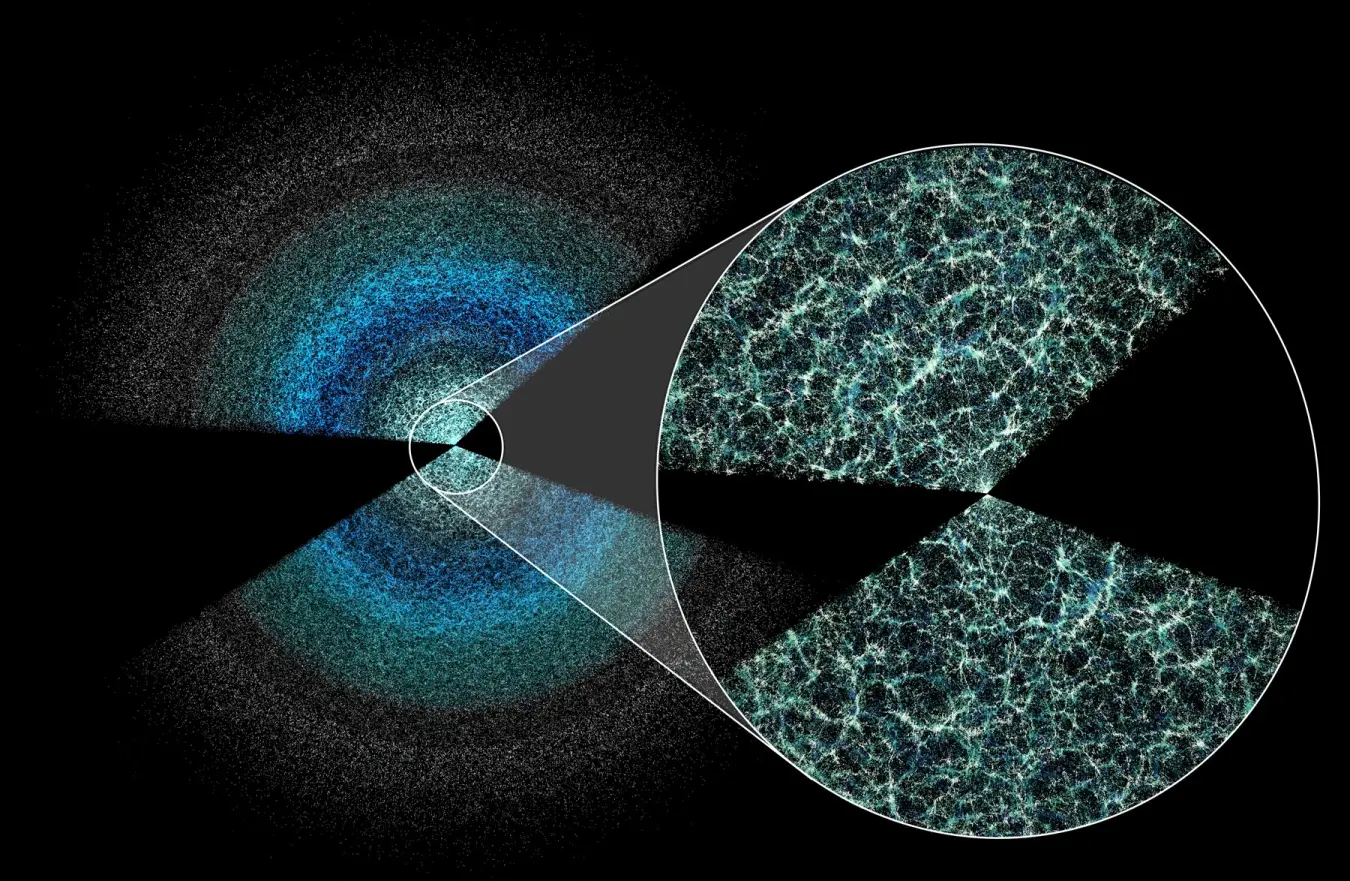
A thin slice of the map produced by the DESI five-year survey shows galaxies and quasars above and below the plane of the Milky Way. The universe's large-scale structure is visible in the magnified inset. Earth lies at the center of the wedges, and the black gap marks where our own galaxy obscures distant objects. Light from the furthest galaxies shown is 11 billion years old by the time it reaches Earth.
Credit: Claire Lamman/DESI collaboration
Dr Seshadri Nadathur co-chaired DESI’s galaxy and quasar clustering working group, leading the effort to extract dark energy measurements from DESI’s map. He said: “It is hard to overstate how important this DESI map of galaxies will be for cosmology.
“The possibility of dark energy evolving with time would be revolutionary on its own, and there are still many other things we can do with the data, including weighing neutrinos, the lightest known fundamental particles.
“We’ve barely scratched the surface so far, and I’m excited to see what else we can learn.”
Professor Ofer Lahav, a member of the DESI Executive Committee who has been involved in the project for over a decade, said: “This is a very exciting milestone. The data-gathering phase has far exceeded expectations. DESI observations processed so far suggest the intriguing possibility that the density of dark energy may evolve over time.
“The collaboration will now analyse the full dataset to test this result, as its confirmation would represent a paradigm shift in our understanding of the universe.
“In addition, the spectra of the 47 million galaxies and quasars form a gold mine for studying how galaxies have formed and evolved.”
Space South Central’s Strategic Partnerships Manager, Dr Elizabeth Clutton, works closely with all four of the cluster’s academic partners, the universities of Portsmouth, Southampton, Surrey and UCL. She said: “Our region’s universities have consistently been at the forefront of space research for decades.
“UCL and the University of Portsmouth’s work on the DESI project gives scientists around the world gain a deeper understanding of the universe and further strengthens our international relationships and collaboration opportunities.”
The collaboration will now begin processing the full dataset, with the first dark energy results from DESI’s full five-year survey expected in 2027. DESI is continuing observations and will extend its map to cover more of the sky to better study dark energy as well as dark matter.